
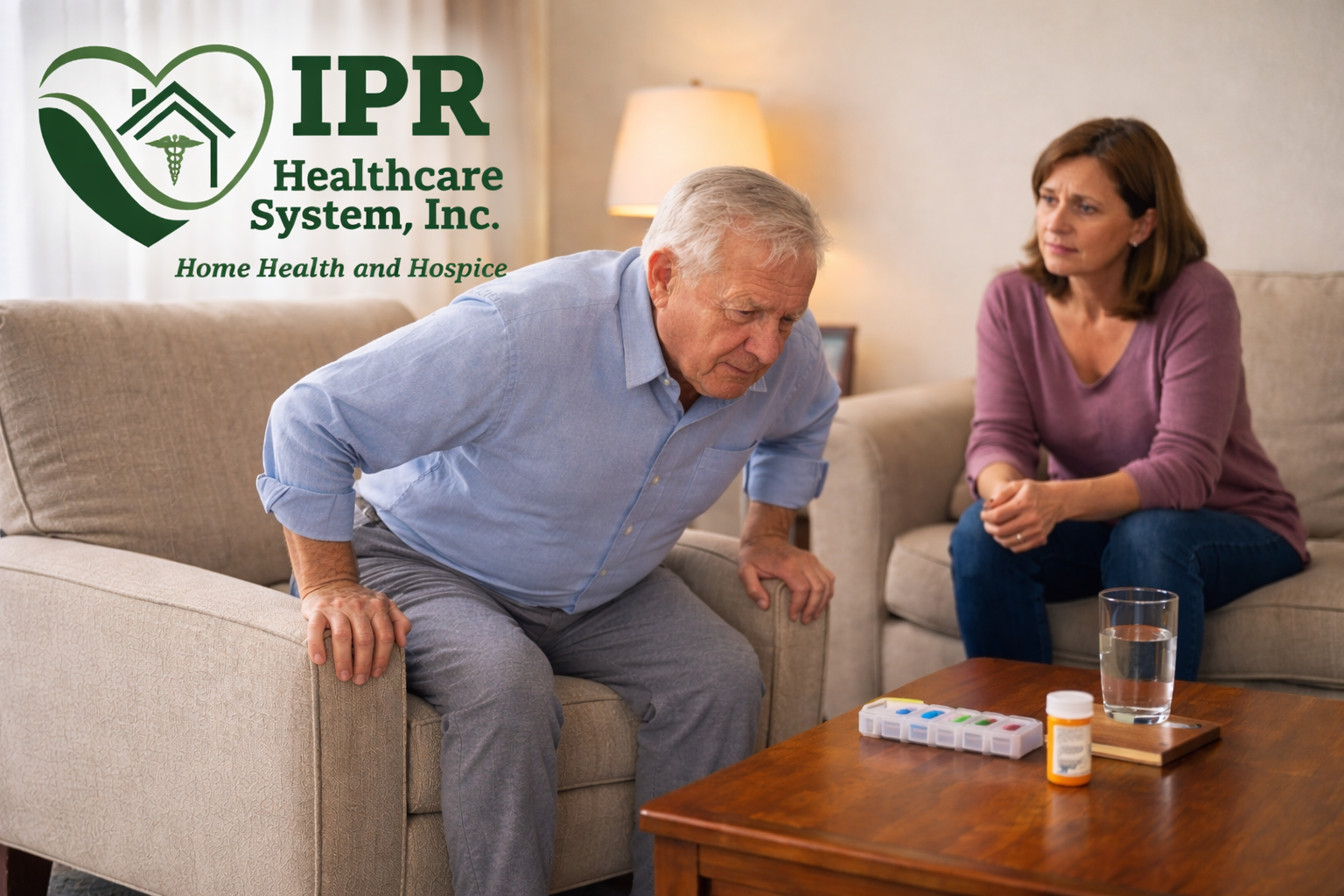
Two days after coming home from the hospital, he tries to stand up.
He places his hands on the armrest, pushes himself forward, and pauses halfway, as if his body is unsure whether it can follow through. His legs feel weaker than they did the day he was discharged. Not stronger. Not improving. Weaker. He slowly lowers himself back into the chair, frustrated, trying not to show it.
Just days ago, he was surrounded by nurses, monitors, and reassurance. Now, it’s quiet.
His daughter watches from across the room, unsure if she should step in or give him space. She replays everything in her head. The discharge instructions. The medications. The expectation that things would start getting better once he got home.
Instead, she’s left wondering the same question most families don’t say out loud:
“Is this normal… or is something wrong?”
This moment happens more often than people realize. It’s not dramatic. It’s not an emergency. But it’s the exact point where uncertainty begins to take hold.
Because the truth is, getting better at home rarely looks the way families expect it to.
Why Recovery at Home Feels So Different
Hospitals are designed to stabilize.
Home is where recovery actually begins.
Inside a hospital, every change is noticed. Vital signs are checked regularly. Nurses respond quickly. Physicians adjust treatment in real time. There is a built-in safety net around the patient at all times.
At home, that safety net disappears overnight.
Now, recovery depends on:
- Strength that may not have fully returned
- Medications being taken correctly and consistently
- Daily movement, even when the patient feels weak
- Nutrition and hydration that may fluctuate
- A caregiver doing their best without clinical training
At IPR Healthcare, we consistently see the most vulnerable period occur within the first few days after discharge. This is when patients are adjusting physically, mentally, and emotionally without the constant support they just left behind.
This is where expectations and reality begin to separate.
The Reality Most People Aren’t Told
Most families expect recovery to be steady.
A little better each day. Clear progress. Visible improvement.
But real recovery is rarely that predictable.
It often looks like:
- A strong day followed by unexpected fatigue
- Progress in the morning and setbacks by evening
- Increased activity followed by exhaustion
- Symptoms that improve slowly instead of disappearing
This pattern can feel discouraging, but it is not a sign of failure.
It is the body working through the stress of illness, hospitalization, and the transition back home.
What matters most is not how each individual day looks, but whether there is gradual movement in the right direction over time.
What Progress Actually Looks Like
Recovery is often measured in subtle improvements that are easy to overlook.
A patient may still feel weak, but:
- They stand a few seconds longer than the day before
- They walk slightly farther, even if slowly
- Their appetite improves just enough to notice
- They require a little less assistance with basic tasks
- They are more alert, more responsive, more engaged
These are clinically meaningful changes.
At IPR Healthcare, our clinicians are trained to recognize these early signs of progress because they indicate that recovery is happening, even when it doesn’t feel obvious.
For families, understanding these small wins can shift the entire perspective of the recovery process.
When Something Isn’t Right
While ups and downs are expected, certain changes should never be ignored.
Families should watch closely for:
- Sudden shortness of breath
- Chest pain or pressure
- Confusion or sudden mental changes
- Fever or signs of infection
- Rapid swelling
- Noticeable decline in strength or mobility
These are not normal fluctuations.
They may signal complications that require immediate attention.
One of the most critical aspects of recovery at home is knowing when something is part of the process and when it is a warning sign.
Why Recovery at Home Can Break Down
Recovery at home is not just about rest.
It requires coordination, awareness, and consistency.
Many patients struggle not because of lack of effort, but because of how complex recovery actually is.
Common challenges include:
- Medications being missed, duplicated, or misunderstood
- Fear of movement leading to further weakness
- Poor hydration that goes unnoticed
- Early symptoms that are subtle and easy to dismiss
- Caregivers feeling unsure or overwhelmed
These issues often build gradually.
By the time they are recognized, they can lead to setbacks or hospital readmissions.
How Home Health Changes the Trajectory
Recovery improves when someone is actively guiding the process.
At IPR Healthcare, we bring clinical expertise directly into the home environment.
Our team focuses on:
- Monitoring vital signs and overall condition
- Ensuring medications are taken safely and correctly
- Supporting mobility to prevent decline
- Educating patients and families in real time
- Identifying early warning signs before they escalate
We do not just follow a care plan.
We adapt to the patient’s condition as it changes, helping families understand what is happening and what to expect next.
This level of oversight often makes the difference between a smooth recovery and a preventable setback.
The Shift Families Need to Make
Recovery at home is not about returning to normal overnight.
It is about steady, consistent progress.
Families who navigate this process successfully understand:
- Improvement takes time
- Setbacks can be part of healing
- Consistency matters more than speed
- Support is not optional, it is essential
When expectations are realistic, stress decreases.
When stress decreases, patients and families are better able to focus on what truly matters, recovery.
The Bottom Line
Getting better at home is not a straight path.
It is a process that requires patience, awareness, and the right support system.
For many patients, the hardest part is not the illness itself, but the uncertainty that comes after leaving the hospital.
But with the right guidance, recovery becomes clearer, safer, and more manageable.
And sometimes, the most important sign that things are going right is not how fast someone improves…
…but that they continue moving forward, even on the difficult days.
Need Guidance During Recovery?
If you or a loved one is recovering at home and unsure what to expect, IPR Healthcare is here to help.
Our team provides skilled nursing, therapy, and personalized support to ensure patients recover safely in the comfort of their home.
Learn more at:
https://iprhealthcare.com/
Follow us for more patient education and updates:
https://www.instagram.com/iprhealthcare.tx/
https://www.facebook.com/iprhealthcaretx
https://www.linkedin.com/company/15583969/